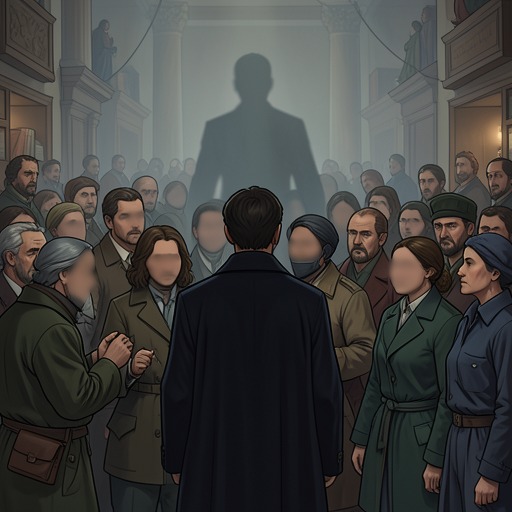
Ted investigates Lauren Freeman’s case
Crimson LakeTed Conkaffey’s investigation of Lauren Freeman’s case begins not with an official interview but with an uneasy visit to her family home. There, he encounters a history shaped by competing recollections, a mother’s continuing attachment, and the physical traces of Lauren’s unfinished adolescence. The visit does not resolve the case; instead, it shows how difficult it is to distinguish evidence from stories people have come to live with—and how Ted’s own public identity shadows his attempt to investigate.
Position and Background
Ted approaches Lauren Freeman’s family as someone investigating similarities among violent cases. At the door, however, he does not present himself under his own name or describe his actual position. He gives the name Ted Collins and claims to work for a historical section of the police, framing his supposed role as the analysis of patterns across cases. His account is a cover story: he is no longer a police officer, and his admission to Paula Freeman is accompanied by visible embarrassment.
The choice to enter under an invented professional identity places the investigation on uncertain footing from the start. Paula has encountered people who come to the house wanting to discuss the case, including self-described witnesses and other outsiders, and initially mistakes Ted for her daughter Dynah. Once Ted says he is connected with the police, Paula welcomes him inside. Her response suggests that the claimed authority changes how she receives him, even as his deception leaves him feeling guilty.
Ted’s own history makes the assumed role especially fraught. He was interrogated for fourteen hours after Claire Bingley’s assault, first by colleagues who had been his friends and then by homicide detectives. The charges against him were withdrawn halfway through his trial because the prosecution judged its evidence insufficient to continue, but he was never acquitted. He describes the distinction as consequential: withdrawal did not establish that he had not committed the crime, and he remained uncertain whether the case might be revived. His visit to the Freeman home therefore takes place against a background in which both official investigations and public judgment have already shaped his life.
The Visit to the Freeman Home
At Lauren Freeman’s house, three small brown dogs crowd the entrance as Ted taps on the screen door. Someone inside tells him the door is open, and he enters. Paula Freeman meets him, supposing at first that he is Dynah. After Ted identifies himself by his assumed name, Paula says she is Lauren’s mother. The exchange gives Ted access to the family, but it also establishes that he is there through a deliberately misleading introduction rather than an openly negotiated conversation.
The visit places him inside a home already familiar to him through Murder in the Top End. He recognizes the house as matching its description in the book and feels as though he has stepped into its pages. That sensation links the investigation to a larger problem: accounts of Lauren’s death have circulated beyond the family, and the written version has become part of how an outsider approaches the place where she lived.
Paula describes the attention the case attracts. In her experience, people claim to have been present on the night Lauren died, though their numbers and accounts do not fit together. She says that nearly a hundred students from Lauren’s school year have claimed to have been there. If all their claims were taken literally, the small gathering she remembers would have become a much larger event. The incompatible recollections leave Paula vulnerable to adopting one version among many, even as she knows they cannot all be true.
Family Memory and Conflicting Accounts
Paula speaks readily about Lauren, while Dynah offers a more guarded perspective. When Paula leaves the room, Dynah tells Ted that her mother does not get to talk about Lauren very much, distinguishing that from the way Paula talks to Lauren. Dynah then explains that, in her mother’s understanding, Lauren is still present in the house. Her dry, sceptical manner exposes a difference between the mother’s continuing relationship with her dead daughter and the sister’s awareness of that attachment.
The exchange complicates any simple picture of the family’s grief. Paula’s stories are not just testimony about the case; they are part of a continuing bond with Lauren. Dynah sees that bond from within the same household but describes it with irony, suggesting that remembrance can both preserve a person’s place in a family and make ordinary conversation about her more difficult. Ted is listening not only for facts about the night of the murder but also for the different meanings the family gives Lauren’s ongoing absence.
Lauren’s Room and the Paper Fortune Teller
Paula shows Ted Lauren’s bedroom, which has been preserved as it was when Lauren left it. The room’s details belong to an earlier period of her life: a teen-era Leonardo DiCaprio poster hangs above the bed, CDs remain on the shelves, and colourful gel pens and folded notes lie on the desk. The preserved arrangement makes the room a material record of Lauren as a young person, distinct from the simplified figure constructed by later accounts of the case.
Among the objects, Ted finds a paper fortune teller folded into a four-petalled shape. Its coloured petals lead to numbered flaps, and the fortunes include the possibility of marrying one’s true love. Someone has added the initials LD beneath that promise in another-coloured pen and drawn a smiley face. The marking is concrete, but its significance is not established: Ted does not identify who wrote it or what the initials mean. Its evidentiary force lies partly in that uncertainty, a small personal trace that prompts questions without answering them.
The room also makes Ted confront the competing versions of Lauren. The young person associated with a teen idol poster and a handwritten note does not sit easily beside descriptions of her as a drinker or a driver, or with the theory that she must have been hated enough to provoke her killing. Ted asks himself which Lauren is real. The question does not deny that any one account may contain truth; it registers how a person can be reduced to separate, incompatible labels once others reconstruct her from fragments.
Public Judgment and the Limits of the Inquiry
Ted’s attempt to investigate the case is inseparable from the judgment attached to his own name. In a bar, customers recognize him and fall silent; he leaves before he is ready to face the attention. Later, after Fabiana Grisham tells him that Australia does not consider him innocent, Ted hears the force of the accusation as a social fact as well as a legal one. His charges were withdrawn, but the public response continues to treat suspicion as settled knowledge.
That response is amplified by media coverage. When a video featuring Ted becomes public, newspapers publish an old mugshot, and he reads through 1,432 online comments. The comments demonstrate the breadth of hostility, not proof of the crime for which he was accused. Ted also reflects that he does not match the public’s familiar image of a violent child offender and believes this mismatch makes him more frightening to people. His own case thus gives him direct experience of how an accusation can govern interpretation even when a prosecution has not established guilt.
The investigation of Lauren Freeman’s case remains unresolved in the material presented here. Ted has entered the family’s home, heard Paula’s account of the proliferating claims to have been present, listened to Dynah’s distinction between talking to Lauren and talking about her, and noticed the initials on the fortune teller. These encounters enlarge the case’s human and evidentiary context without producing a definitive answer. The visit’s significance lies in that restraint: Lauren emerges not as a single story to be solved by assumption, but as a person whose family memories and surviving belongings complicate every version told about her.